ABOUT THE MADONNELLE DI ROMA PROJECT

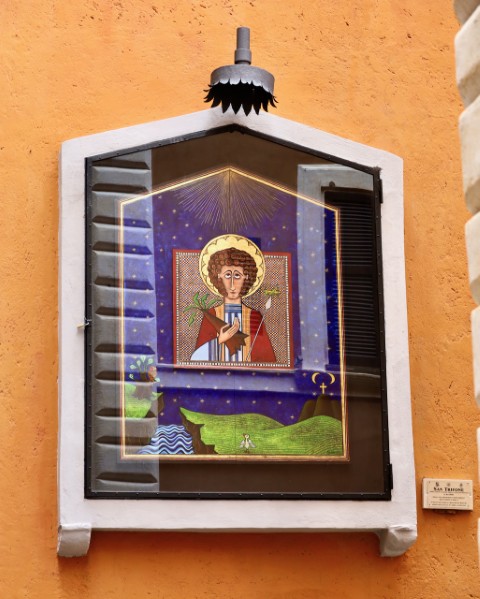
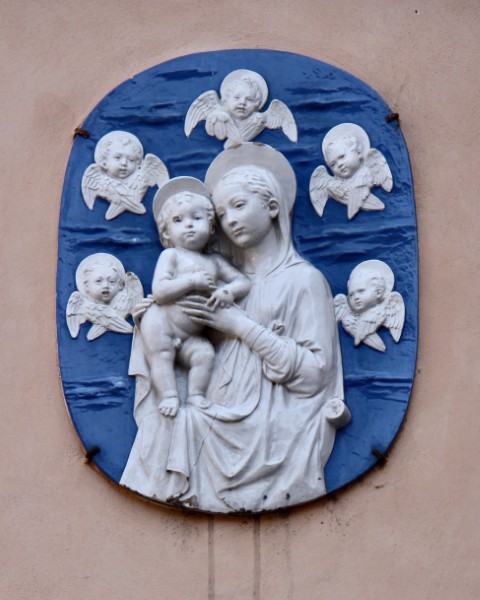
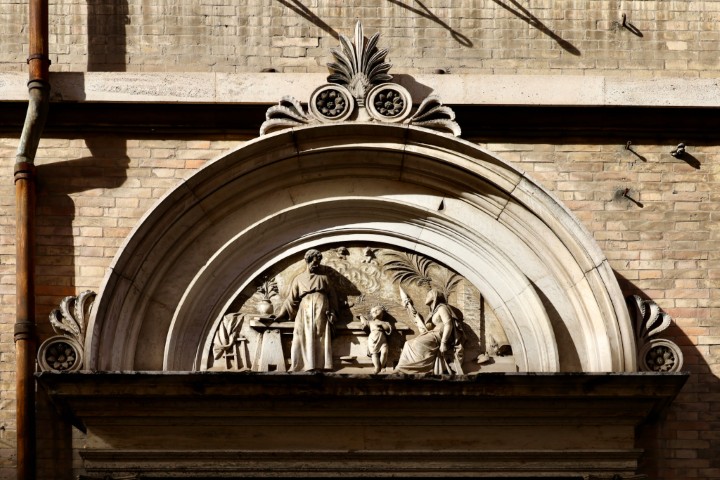
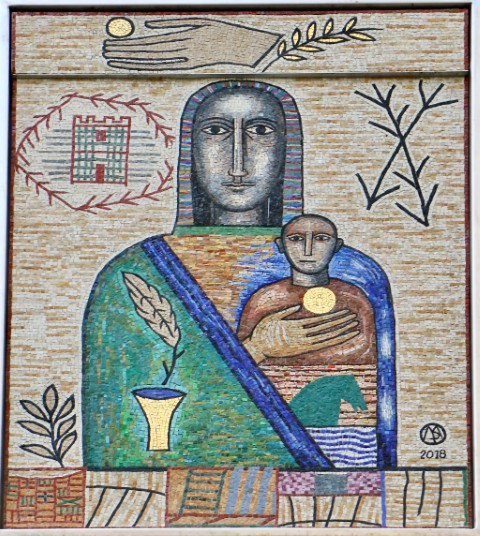
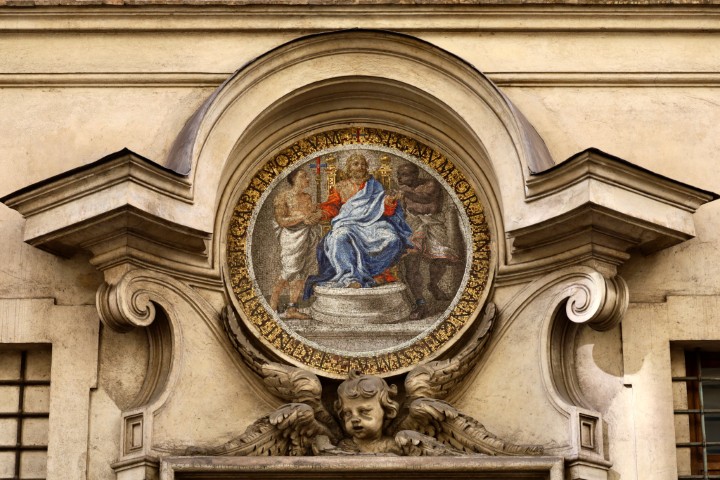
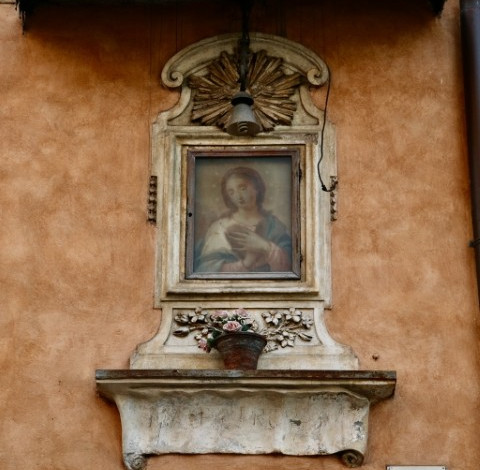
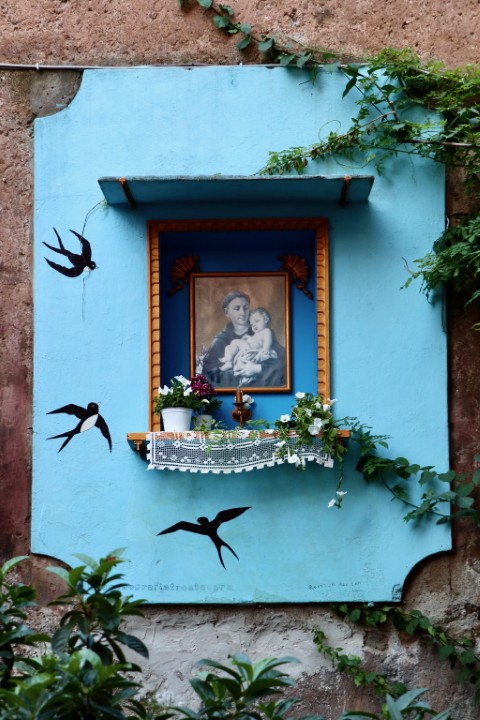
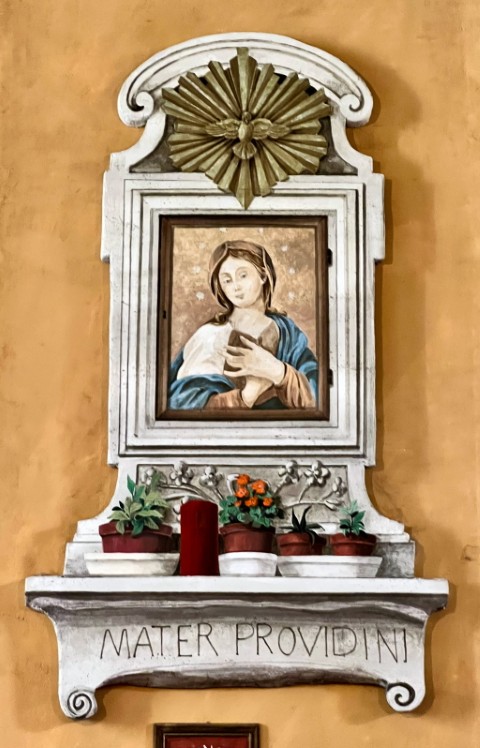
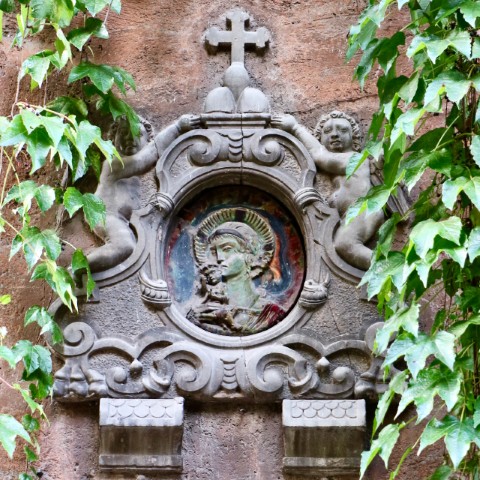
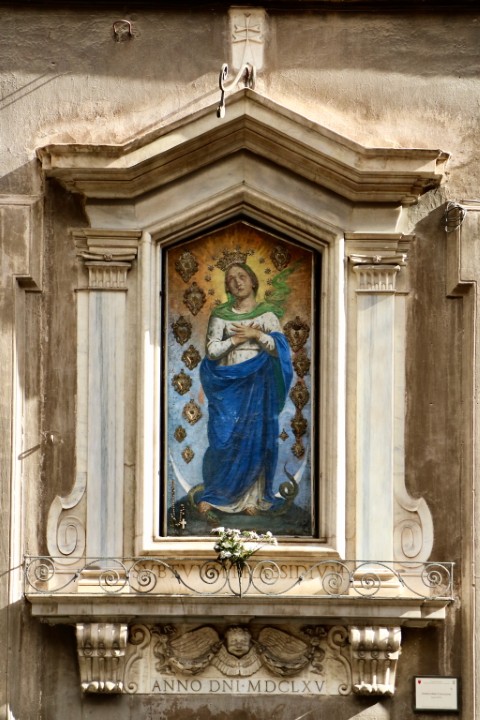
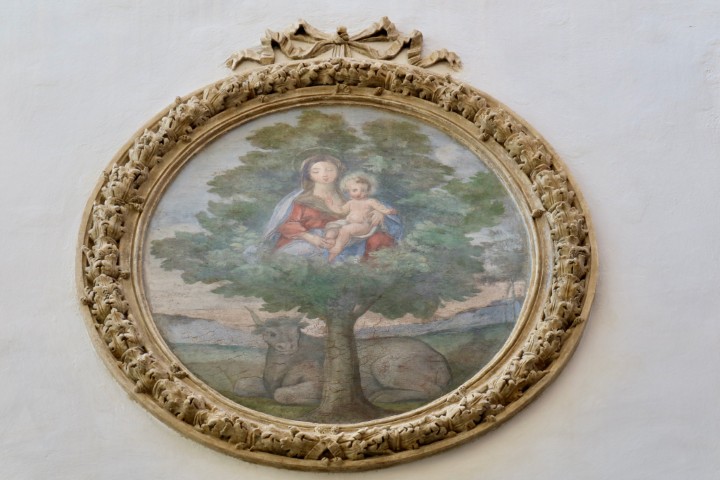
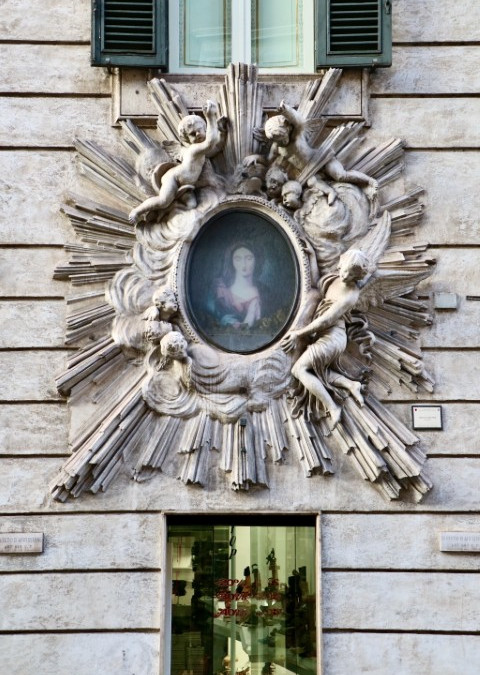
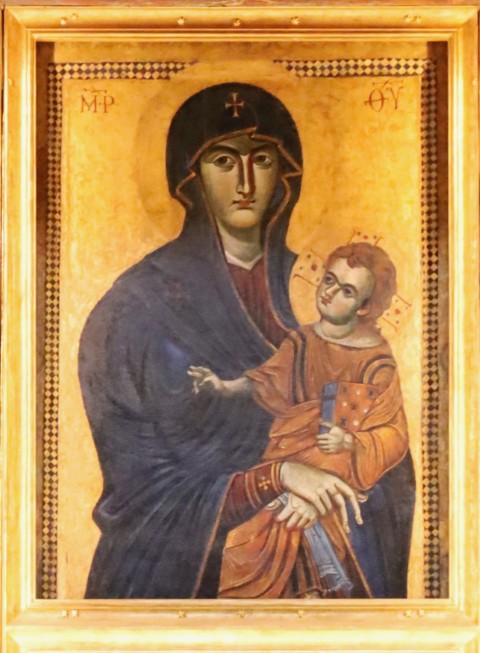
Among Rome’s most ubiquitous and compelling sights are the city’s Madonnelle—popular street shrines that, as their name suggests, predominantly contain images of the Virgin Mary, though they could also include Christ, saints, or other religious figures and patrons. They appear on houses, palaces, street corners, above doorways and windows, not to mention more conventional places such as church facades and they are unmissable because they are often framed in lavish, eye-catching niches, topped by canopies, or surrounded by extravagant, radiating whiteen beams and sculpted angels. As a form of street art, the Madonnelle are witness to the power of imagery on the lives of the people that encounter them.


Like the broader category of street art, the democratic nature of the Madonnelle requires no curation or control, and invites no exclusivity. Indeed, they are available to all who live in the neighborhood, or merely pass through, and they have provided comfort, wonder, and joy for centuries. Their enduring power is evident in the shrines that are still cared for and offered gifts of thanks, and by the appearance of new interpretations and iconographies in twenty first-century instances. This became apparent in recent years, as Madonnelle tend to proliferate in troubled times when plague, war, and impending disaster cause anxiety. At once, they offer connection to and comfort from the Divine.
Descriptive alt text for image on left

Today, within the Aurelian Walls, there are more than 800 Madonnelle. As the subject of local devotion, they are included in annual festivals and pilgrimages, said to perform miracles, and, thus, fully integrated into the life of the city; and even for the non-religious, they attract attention for their beauty, variety, and history. All told, Madonnelle reflect important spiritual, political, and artistic facets of the Eternal City. Our Madonnelle di Roma project began in 2008 as an effort by Charlotte Bialek to photograph, map, and record in a database as many Madonnelle as possible. In 2023, Nicola Camerlenghi and students at Dartmouth College joined the project. We began to use Charlotte’s map, data, and images as a basis for research into the Madonnelle and are now expanding our understanding of their history. For example, the team is plotting and recording the 1,421 Madonnelle published by Alessandro Rufini in 1853, which appear in yellow on our map and database. Soon, we foresee offering an annotated transcription alongside an English translation of Rufini’s work. To enrich the website, students and scholars curated “Perspectives” (found at top right) that consider urban pathways in relation to the Madonnelle as well as specific Marian iconographies. Our aim is to continue enlisting individuals in the United States and elsewhere to expand our research.
Descriptive alt text for image on right


About Us

Charlotte Bialek

is an artist and photographer living in New York City. She has visited Rome many times, beginning with a four month stay in the spring of 2008. At that time, she became enamored of the beauty and variety of the Madonnelle and began to take photographs of them and their broader context on the street. Since then she has developed a database of nearly 900 Madonnelle with detailed information about their characteristics and has mapped them on Google MyMaps. She hopes to continue photographing those labeled NP (Need Photos) on her next visits to this great city. With Chiara Calpini, she published information about some of the Madonnelle on Instagram

Nicola (Nick) Camerlenghi

is Associate Professor in the Department of the History of Art at Dartmouth College where he specializes in the study of Early Christian and medieval architecture, with particular interest in the city of Rome and the area of the Mediterranean. His first book, Paul’s Outside the Walls: A Roman Basilica from Antiquity to the Modern Era , was published in 2018. A volume he co-edited, entitled Practices and Heuristics of Digital Models in Art History was published in 2024. He is lead researcher of the "Mapping Rome” research group, whose cartographic and visual assets have proven useful for this project.

Giovanni Svevo

holds a BA and a Professional Doctorate in Classical Archaeology from the University of Rome, ‘La Sapienza’, and an MS in Geography and a Graduate Certificate in Geographic Information Science from Oregon State University. He worked as a professional archaeologist between 2001 and 2015, specializing in the application of GIS and photogrammetry to archaeological fieldwork. Since 2015 he worked as a Digital Humanities specialist on projects with the University of Oregon, Stanford University, Dartmouth College and Oregon State University.

Chiara Calpini

is a Rome-based journalist and social media specialist with over 30 years of experience in publishing and editorial projects. She founded and directed national magazines and online platforms, and has also worked in institutional consulting and press. Her reporting focuses on arts and social trends. Currently specializing in Digital Humanities for the Communication of Archives on the Web, she promotes Rome’s cultural heritage through digital communication. As ambassador and press officer for the Madonnelle project, she coordinates research initiatives, fosters institutional collaborations, and manages its bilingual communication and social media presence

Leandro Sala

He holds degrees in Literature, Geography, and Law from Sapienza University of Rome, is a registered journalist, and a scholar of modern Roman history. In his journalistic career, he has collaborated with various publications and, in particular, for 22 years, with Italia Turistica, both as a photographer and text editor, receiving four journalistic awards for his work. He has published with Ricciardi & Associati: in 2009, Altari all’aperto: Le edicole Sacre di Roma, Vol. I; in 2015, with Anna Maria Carioni, Altari all’aperto: Le edicole Sacre di Roma, Vol. II; in 2019, he collaborated with C. Sebastiani Zoli, also as the photographer, on the book Sant’Ignazio di Loyola in Campo Marzio; in 2024, Le Mura ci parlano: Confraternite, Associazioni di Nazionalità, Arti e Mestieri di Roma, attraverso le Targhe proprietarie, Vol. I. He also collaborates with the Roman publications of the Italian Academy of Cuisine on historical research topics.

Luisa Cardilli

is an art historian who worked at the Superintendency for Cultural Heritage of the Municipality of Rome, where she directed the department for Medieval and Modern Monuments. She is an expert in the conservation, safeguarding, and enhancement of the city’s cultural heritage. Since 1981 she has dealt with the cultural assets of dissolved hospital institutions. Among the restorations she oversaw are those of the fourteenth-century frescoes in the Oratory of St. Margaret in a tower of the Aurelian Walls, the Trevi Fountain, the Spanish Steps, the Porta del Popolo and Porta Pia. Among her publications are the series Restauri in piazza, Restauri per la città, I quaderni dei monumenti, and two volumes on sacred shrines produced for the 1990 exhibition and restorations carried out for the Jubilee of 2000. Among the conferences she curated are those on Rome’s urban furnishings from Italian unification, on the coloring of historic buildings, on urban graffiti and intervention methodologies, as well as the international conferences: “The Ancient Hospital of Santo Spirito, from Papal Institution to Third-Millennium Healthcare” and “Water, Stones, Bronzes: Monumental Fountains, Management and Conservation—Compared Experiences.”
Student Contributors

Grace Wilkins

is a member of Dartmouth College's class of 2026 with a double major in Economics and Italian. In 2024, she studied economics at Università Bocconi in Milan as part of an exchange program, which deepened her interest in the country’s language, culture, and urban history. On campus, Grace is an Italian drill instructor and a Dartmouth Economics Research Scholar, where she researches U.S. tariff exclusion policy. She is also Vice President of Operations for the Dartmouth Political Union, a business staff member at The Dartmouth, and a member of the Club Triathlon Team.

Timothy O’Reilly

is a member of Dartmouth College’s class of 2025 with a major in History modified with Economics, and a minor in Italian. His academic and extracurricular work reflect a strong interest in the intersection of these three disciplines; he has participated in a language and culture study abroad in Rome, and interned at a research institute in Northern Italy focused on local development. Tim looks forward to further exploring Rome’s architectural history and understanding how the city’s built environment has evolved over the years.

Louise McKown

is a member of Dartmouth College's class of 2026. She is a History major and Art History minor and has participated in Dartmouth's Art History Foreign Study Program in Rome. Her time abroad instilled in her a passion for Roman architecture and a deeper love for the Madonnelles found all throughout the city.

Emil Liden

is a member of Dartmouth College’s class of 2025. An Art History major modified with Philosophy and a Digital Arts minor, Emil studied in Rome on Dartmouth’s Art History Foreign Study Program in 2024. Emil has also worked on the Augmendo team, combining art history with cutting edge technology to help develop this augmented reality museum mobile application

Sophia Lachenauer

is a member of Dartmouth College’s class of 2024. An Art History major and a French minor, Sophie studied in Rome on Dartmouth’s Art History Foreign Study Program in 2022. The curriculum inspired her interest in the architecture and urbanism of Rome and spurred her to join the Mapping Rome team. Sophie has also participated in Dartmouth's programs in Toulouse and Paris, where she further studied the architectural history of European cities.

Brian Zhang

is a member of Dartmouth College’s class of 2024 and a double major in Computer Science and Art History. He is interested in all types of art but especially the classics and Japanese sacred imagery. Brian helps out with mapping the Madonnelle of Rome, which reflects his interests between art and religion. Outside of the classroom, he enjoys reading Percy Jackson, researching Japanese culture, and learning finance. You might also find him playing video games.

Milanne Berg

is a member of Dartmouth College’s class of 2024 with a B.A. in Art History. Her research centered on the Assumption Procession pathway in the Monti rione of Rome. Milanne attended the 2022 Rome Art History FSP, which led to her interest in the madonnelle shrines that decorate the city's streets. Her work on the madonnelle website was influenced by her larger goals to help make art history knowledge more accessible to the public. She now works at the Institute of Contemporary Art, in Miami, and hopes to continue her independent research on queer and feminist contemporary art in the future.

Brandon Mioduszewski

is a member of Dartmouth College’s class of 2025. He is studying Anthropology and Middle Eastern Studies, and passionate about documentary filmmaking and visual storytelling that shares lived experiences of communities around the world. He used his love for visual storytelling to craft online story maps showcasing the Madonnelle of Rome that attract attention for their sanctity, beauty, variety, and history.

Luis Hinojosa

is a member of Dartmouth College’s class of 2024 and a major in History and Italian studies. Following a study abroad program in Rome, he embarked on this project.

Camille Yang

studies a mixture of Computer Science and Digital Art and Film at Dartmouth, where she aspires to craft immersive experiences to better our understanding of the world. Outside of this, you’d find her sketching, learning languages through films and audiobooks, watercolor painting in nature, video editing and designing motion graphics, and recently making comics.
Other Contributors

Claire N. Ptaschinski

is a Ph.D. candidate in the History of Art & Architecture at the University of Pittsburgh and an Associated Researcher at the Royal Netherlands Institute in Rome (KNIR). Her dissertation investigates the impact of natural disasters, particularly that of flooding, on the art, architecture, and urban landscape of Baroque Rome. Prior to joining the University of Pittsburgh, Claire worked in the Center for Renaissance Studies at the Newberry Library in Chicago where she had the opportunity to contribute, among other things, to the development of a new Italian Paleography website and a print catalogue published by Northwestern University Press for the exhibition, "Renaissance Invention: Stradanus's 'Nova Reperta.'"

Alessandra Batty

is an Associated Academic at Bonn University. A classicist, she holds at first degree and a postgraduate degree at the Università “la Sapienza” (Rome), and an MA in Archaeology and PhD in History of Art from the University of Manchester (UK). Her main research interests are the history of archaeological studies, the structural and social analysis of monuments (with a focus on Ostia) and the material culture, sacred landscape and visual environment of historical Rome. Among her publications are a monograph on the Domus del Ninfeo at Ostia (BAR, 2018), the English edition of Giuseppe Maggi’s book on Herculaneum (Kairos, 2021) and a monograph on slavery in Roman domestic contexts (BCDSS, 2025).